
BEGINNINGS
I was born near Birmingham, in the heart of England, and grew up in Smethwick. As a child in the 1960s, I found myself irresistibly drawn to the new and unfamiliar sounds of electronic music that I occasionally encountered on television and radio. Even at such a young age, conventional instrumentation seemed old and all too familiar, whereas these new sounds were futuristic, vibrant and full of colour.
During the early 1970s, I began seeking out albums featuring the synthesiser, including Perrey & Kingsley’s Kaleidoscopic Vibrations, along with other Moog-based recordings such as Marty Gold’s Moog Plays the Beatles, Walter Carlos’s Switched-On Bach and TONTO’s Expanding Head Band’s Zero Time.
An immensely powerful impression was made upon me when I first heard Tangerine Dream in 1972, during a live broadcast from Germany on the BBC. This was well before John Peel began giving the group airplay on Radio 1. The experience was akin to a mystical awakening, as though something within the music were calling out across vast distances of space and time. I had a strong sense that the music was forging a bridge between other worlds and dimensions. This awareness of the almost magical possibilities of music inspired me to begin my own explorations into the realms of sound.
My recording of that fateful first encounter with Tangerine Dream. The video features some of my early 70’s artwork.
As the decade progressed, I was also drawn to the work of bands such as Yes, ELP and Genesis by their use of the synthesiser, together with the more experimental sounds of Hawkwind, Gong and, of course, Tangerine Dream. My musical interests were already beginning to extend well beyond conventional boundaries.
In the early 1970s, I attended Oldbury Technical School, where the famous comedian Frank Skinner was also a pupil. It was here that I met Linda, who would eventually become my wife and an important part of my musical journey. I subsequently gained a place at Wolverhampton College of Art, although, as the decade progressed, music increasingly began to take hold of my imagination and life.
THE EARLY YEARS – 1972–1979
Although my first ‘official’ release was 1983’s From Distant Shores, my recording experiments had actually begun much earlier, in 1972, when I was just 15 years old and still at school.
During that same year, I quite accidentally created my first rudimentary audio generator. Having developed an interest in electronics, and with a rather inquisitive mind, I somehow got it into my head to dismantle an old tape recorder and see what would happen if I connected its electronic circuit board to the family record-player amplifier.
To my amazement, an extraordinary variety of electronic sounds emerged from the loudspeaker! These included not only oscillating whistles but also strange rhythmic patterns, bubbling noises and white noise. Inadvertently, I had created an instrument capable of producing sounds not unlike some of those I was hearing on the albums of the aforementioned bands.
Later that year, I purchased an oscillator from a local electronics shop and discovered that, by combining it with my audio generator, I could control and manipulate its sounds. Pitch was controlled not by a keyboard but by a simple knob. It was a strange little contraption, with pieces of Meccano serving as electrical contacts, jutting out of a red and white wooden box that I had built to house it.
You can see it in the photograph below, which was taken by my father around 1974, when I was aged 17–18 years old.
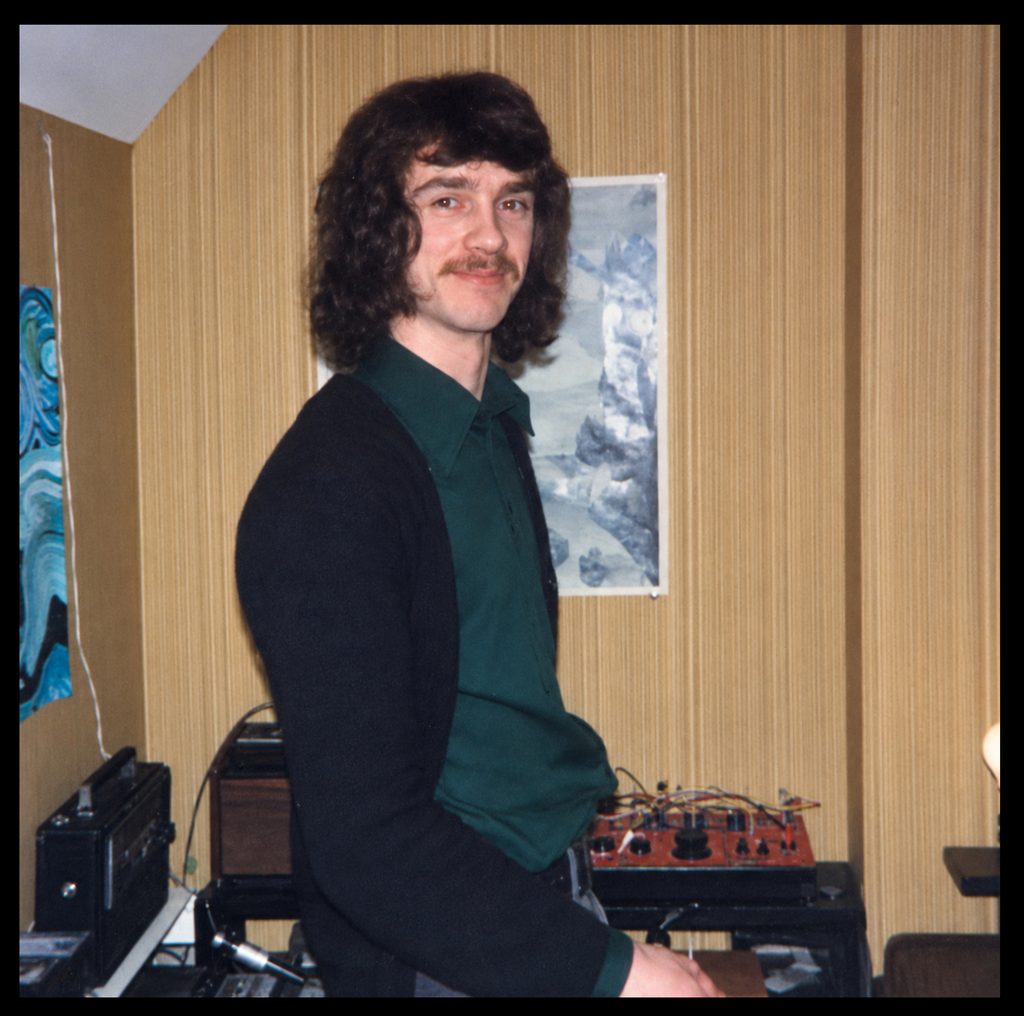
I subsequently named my creation Synda. It also possessed the rather curious ability to transmit its sounds into the ether, as the family transistor radio was able to pick them up! Being a rather strange child, I even entertained the somewhat bizarre notion that some form of small entity was attached to it. But I digress…
Using a small reel-to-reel tape recorder, I began experimenting with recording sounds and then playing them back while simultaneously recording new sounds onto a cassette recorder, or vice versa. In this way, I started creating my own rudimentary sound collages, incorporating whatever happened to come to hand alongside Synda. These included shortwave radio sounds and even the commandeering of my younger siblings’ acoustic guitar and chord organ!
One of my many improvisations that I recorded with my audio generator – here’s “Psychic Remnant” from 1974.
I had no musical knowledge or formal training at the time. I would, for example, invent my own tunings for the guitar and only later began teaching myself to play, starting with the humble descant recorder!
In late 1975, I purchased a full-sized acoustic guitar. Synda Mk. II was built around late 1975 to early 1976 and incorporated the original generator and oscillator, together with an envelope generator, reverb and ring modulator. By now, it had become a completely self-contained and portable unit, with its own loudspeaker.
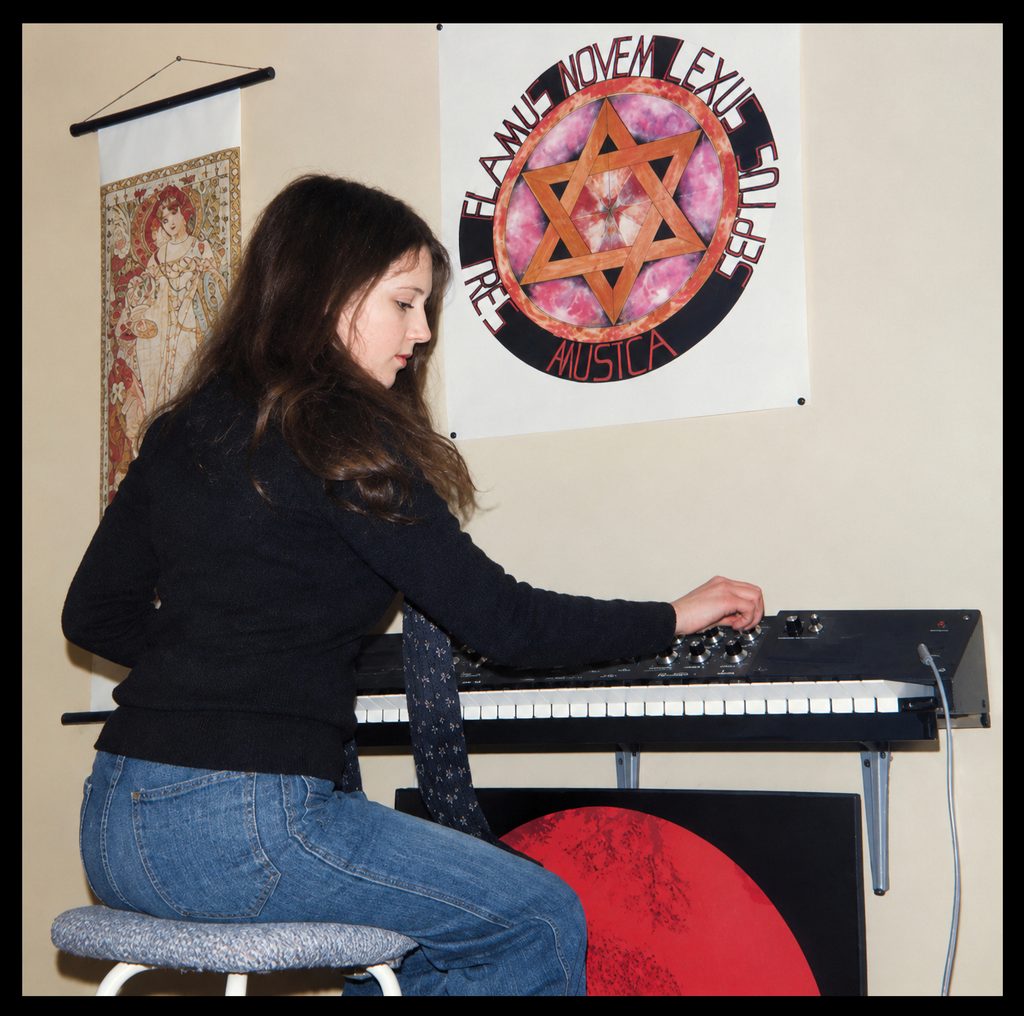
In 1976, I began courting Linda, whom I had known since our school days. In August of that year, I built a Minisonic Synthesiser, which Linda had purchased in kit form, based on a design published in Practical Electronics. It featured a keyboard, although it had an unfortunate tendency to go wildly out of tune!
Photo below taken by me in 1976 of Linda with the Minisonic.
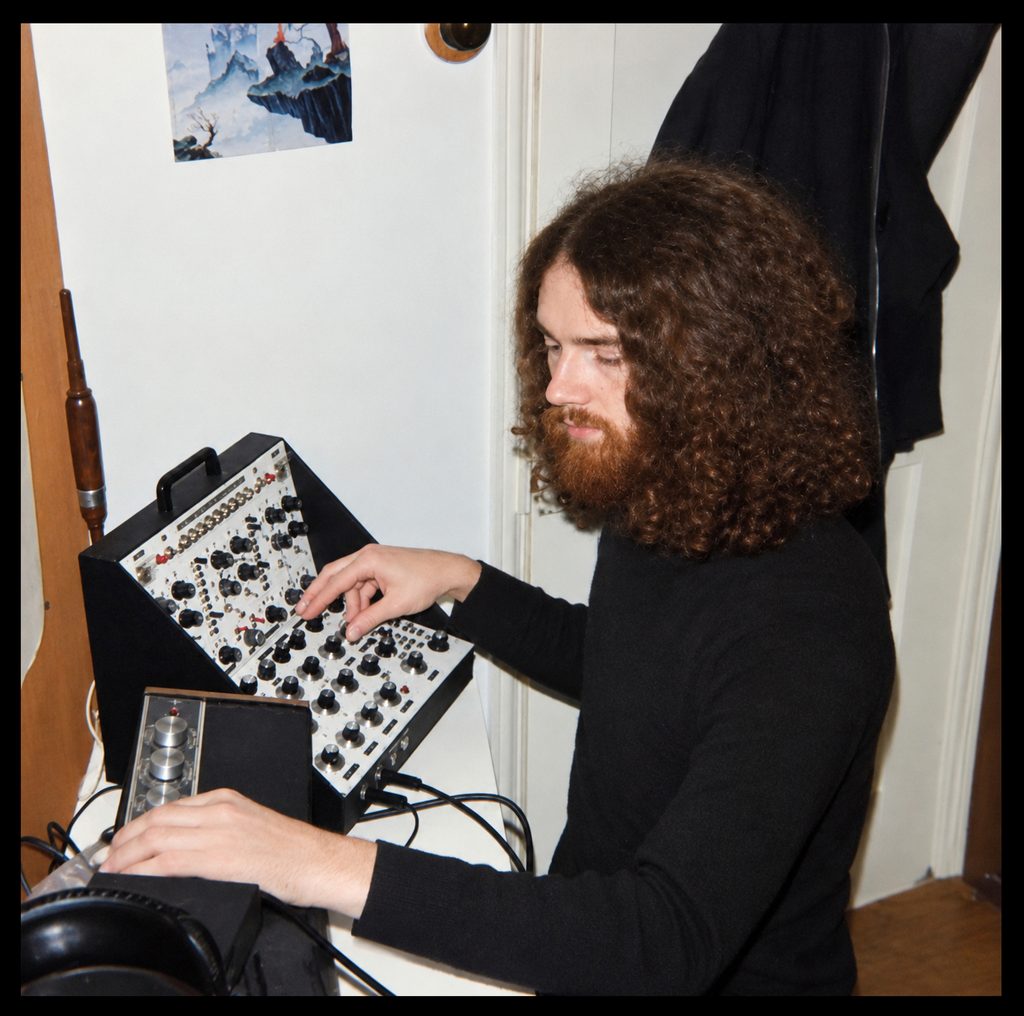
Around 1977, I redesigned the casing of Synda along the lines of the classic VCS3 synthesiser. This Mk. III is the surviving model. The ‘gull’-like sounds that open my 1983 album From Distant Shores were created using it, and I also used it on my 1985 album Evocations and my 1994 album Matrix.
You can see it in the photograph below, taken by Linda in 1978.
In June 1977, Linda purchased an Akai reel-to-reel tape recorder, which opened up a whole new range of possibilities for me, allowing experimentation with stereo recording, sound-on-sound and echo effects.
The following month, I acquired a second-hand Jumbo Gem Electronic Organ, while Linda acquired her first flute, a Boosey & Hawkes concert flute, and began taking flute lessons. In September she started attending Birmingham School of Art.
In early 1978, Linda bought me a new acoustic guitar, my first electric guitar and a Watkins Copycat tape echo machine. I also designed and built an electric cimbalom.
In October of that year, I managed to obtain a Korg Micro-Preset M-500 synthesiser on loan from a mail-order company for six weeks. During that time, I recorded several hours of improvisations onto the Akai reel-to-reel tape recorder before having to return it. Even though it was considered a budget synthesiser, it was still well beyond my means back then! In 2025, I finally released four download compilations featuring the best of those Korg improvisations.
Throughout this period, my musical interests were becoming increasingly diverse, encompassing medieval, Baroque, classical, folk, Eastern, film and progressive rock music, among many other styles. I also enrolled on several music courses and passed a number of grades in music theory. However, I remained largely self-taught in sight-reading, composition, guitar and keyboards. All these influences, together with my early experiments in electronic sound, would leave their mark on my musical output in the years that followed.
In 1979, Linda and I married and set up home together, with her continuing to support and encourage me in my musical endeavours.
Unfortunately, none of my original 1972 recordings have survived, although many from 1973 onwards remain. In 2020, I began releasing a series of eleven digital download volumes under the title PSYCHIC REMNANTS, featuring some of the best material from this period, covering the years 1973–1979.
These were, admittedly, extremely rudimentary and primitive improvisations, but they provide an interesting insight into my earliest musical experiments and offer an indication of the various musical directions and genres I would go on to explore in later years.
During 2026, I condensed those original eleven volumes into three limited-edition CD-R releases. The first is now available through my Bandcamp page, with the remaining two to follow in due course.
THE 1980’S ONWARDS WILL FOLLOW SHORTLY…